All
Top Web App Development Companies in the UAE (2026)
UAE is an emerging technology market and is also called the Silicon Valley of the Middle East. It…


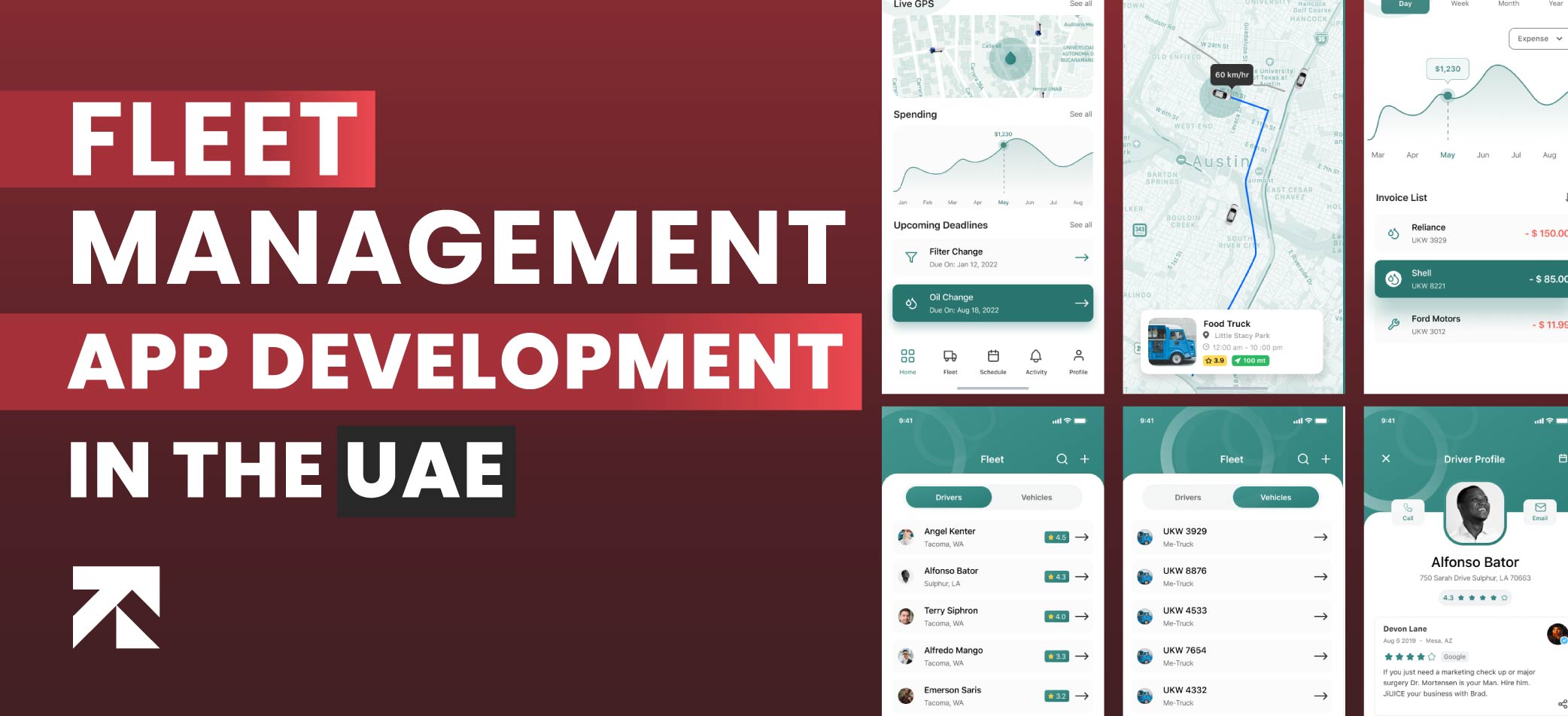
UAE is one of the fastest-growing countries in the world. It handles thousands of deliveries every day, including trucks, delivery vans, taxis, buses, and company cars.
Thank you for reading this post, don't forget to subscribe!Businesses rely on vehicles to deliver products and provide services. Furthermore, soaring fuel prices, strict compliance standards, and growing customer demands have reshaped fleet management in the UAE.
Manual tracking is outdated; businesses across the UAE are investing heavily in fleet management app development.
Investing in fleet management app development provides complete visibility through real-time vehicle monitoring, predictive maintenance, and performance analytics.
Businesses investing in smart fleet management solutions are gaining more control over their fleet management operations.
A fleet management system combines SaaS with integrated vehicle-based technology. This system helps improve overall fleet efficiency, compliance and visibility.
A fleet management system consists of the following components:

A fleet management system creates a continuous data loop between hardware, cloud pipelines and end-user applications. This automates the entire logistics process.
Modern fleet management software follows a layered architecture that allows real-time tracking, third-party integrations and scalable data processing.
A fleet management application operational pipeline:
Installed in vehicles to collect key data such as GPS location, fuel levels, and driver behavior metrics. It also collects telematics and sensor data from connected vehicles.
Message brokers act as a central nervous system, ingesting high-velocity data streams. It splits that high-velocity data into isolated topics like location updates, diagnostic trouble codes and alerts.
It then securely ingests and processes high-volume telemetry using event-driven messaging.
Manages tracking, dispatch, maintenance, compliance and reporting.
It combines relational, in-memory and time-series databases for different workloads.
Provides real-time information through web dashboards, mobile apps and APIs.

Rising fuel charges remain one of the biggest burdens on transportation companies across the UAE.
Traditional tracking methods cannot give you in-depth insight into waste, route inefficiencies and unauthorized vehicle usage.
This financial pressure encourages businesses to adopt fleet management systems that offer real-time fuel monitoring and consumption updates.
Custom fleet management software monitors idling time, harsh acceleration, route deviation and engine performance to identify patterns that are increasing fuel consumption.
All of this smart monitoring data allows managers to implement driver training when necessary and optimize their strategies.
It also results in reduced operating costs and supports sustainability goals by minimizing emissions.
Fleet management systems in Dubai optimize high-velocity operations through dynamic route optimization, as algorithms recalculate delivery paths in real time to cross heavy traffic zones.
They also let businesses share live tracking links with customers, which reduces failed delivery attempts and improves satisfaction.
Furthermore, for temperature-sensitive groceries, meal and pharmaceutical deliveries, it offers instant alerts if the temperature of the cargo fluctuates during intense summer heat.
As the UAE faces extreme heat due to deserts, it often causes vehicle depreciation, battery drainage, and tire degradation. But fleet management apps mitigate these risks by monitoring the exact engine hours and mileage. They also trigger automated alerts for preventive servicing before a vehicle breakdown on the highway.
Drivers also often leave the engines idling to keep the air conditioning running during extreme heat conditions. But fleet management apps track the fuel wastage from engine idling.
UAE is committed to building sustainable, AI-driven cities. Fleet management apps help businesses align with these national mandates.
They lower fuel consumption, reduce engine idling, and optimize routing in order to support the UAE’s net-zero target and eco-friendly smart city blueprints.
Many localized fleet management apps offer bilingual dashboards in both English and Arabic that integrate directly into ERP platforms, providing clean data for broader government-backed digital transformation goals.
For operating a fleet in the UAE, you must comply with strict regulatory requirements and government regulations.
Fleet management apps simplify this process. They offer automated tracking of licenses, permits, inspections, and necessary maintenance schedules.
They also keep a complete record of audits, guaranteeing compliance with minimal administrative burden.
Utilizing a fleet management app in the UAE gives access to predictive maintenance tools. These tools provide real-time diagnosis and performance analytics.
These systems track engine health, battery health, tire pressure and other important factors.
A fleet management system offers real-time tracking that allows dispatch teams to track every vehicle’s movement.
It also responds instantly to traffic disruptions and emergencies. You can also get full access to drivers’ activity, guaranteeing accountability and operational discipline.
In the end, these factors allow businesses to strengthen their efficiency and stand apart from others in the competition.
| Types of Apps | Work |
| GPS Tracking & Telematics Apps | Offer real-time location tracking, driver behavior monitoring, vehicle diagnostics and maintenance scheduling |
| Logistics/Delivery | These apps offer optimization of goods movement from warehouse to final destination |
| Rent a car | Give users short-term vehicle utilization, customer access and inventory control. |
| construction/heavy equipment | These fleet management systems manage high-value off-road assets and goods. |
| school/staff transport | These fleet management apps prioritize safety by offering features like rider check-in, parent/employee portal, route compliance and shift management. |
| Cold chain | These specialized fleet management solutions transport temperature-sensitive cargo like perishables and pharmaceuticals. |

A fleet management app has three panels: one for the fleet manager, one for the driver app, and one for core operations.
Must-have features of all these separate panels are as follows:
It allows fleet managers to track the live location of the drivers. They also get real-time vehicle position information, speed, heading and traffic overlays.
It offers a safe-driving zone setup and sends instant notifications for speeding, harsh braking, and unauthorized detours.
It has granular permission settings for admins, dispatchers, mechanics and finance.
Send instant updates through push notifications for pickup details, drop-off points and schedules.
Offers turn-by-turn GPS routing via Google Maps or Mapbox APIs with live traffic updates to avoid delays.
Provides pre-trip and post-trip vehicle inspection of tires, brakes, and lights to guarantee safety before hitting the road.
It captures digital signatures, images of delivered goods and/or barcode scans directly through the app.
This feature allows you to call for help in one tap. It also sends your exact location to emergency services right away.
It has two language options, which is important for a mixed workforce and local rules.
It uses algorithms to arrange multiple stops, reducing mileage, ETA windows and carbon footprints.
It helps you track fuel purchases, identifies sudden drops in fuel levels and calculates fuel efficiency per vehicle.
It provides automatic reminders for routine servicing, such as oil changes and tire rotations, based on mileage or time intervals.
Tracks telematics data like harsh braking, rapid acceleration and speeding to generate safety scores.
Send notifications to managers before vehicle registration (Mulkiya) and commercial license or driver permit expiry dates.
Artificial intelligence has become a critical part of fleet management app development. AI-powered systems can help in analyzing the historical fleet data to identify trends, predict maintenance requirements and improve resource management.
Predictive maintenance is one of the most valuable and critical factors of fleet management systems. It lets businesses use real-time data and predictive models to detect which vehicles may require service before a breakdown occurs.
AI-powered dashcams act as active and real-time co-pilots. The cameras scan the road to search for collision risks, lane drifting and tailgating.
Telematics hardware collects information about vehicle location, mileage, fuel consumption, and driver behavior.
By integrating this data into a centralized fleet application, businesses can get valuable information like real-time operational insights thats difficult to gather manually.
Integrated IoT sensors to protect physical cargo and optimize mechanical health. During extreme heat conditions in the UAE, they track tire pressure and internal temperature in real time. This helps prevent high-speed blowouts and increases the tire’s life.
Furthermore, the magnetic door sensors track exactly when, where, and for how long the trailer doors are opened.
This feature offers automated toll auditing, with applications pulling data via APIs from Dubai’s Salik and Abu Dhabi’s Darb.
It compares the toll charges with a vehicle’s GPS data to fix errors and confirm the exact route taken.
Fleet management apps also work as a mediator to connect operations with financial pipelines such as ERP synchronization. It helps with automated calculations of vehicle depreciation, work orders and accurate asset valuation.
You can also integrate it directly with fuel providers like ADNOC Voyager or ENOC E-link to automatically pull digital receipts.
Furthermore, the accounting and payroll automation includes driver hours and behavior scorecards directly into the accounting system. It calculates all the factors like overtime, driver bonuses, and client invoicing.
It processes a huge amount of data automatically, so managers dont have to deal with hundreds of raw data points. It also provides a concise overview and mentions the top 3 underperforming drivers.
It also points out the sudden spikes in fuel spend and suggests ways for route optimization.

Development of a Fleet management app starts with understanding your operations’ specific needs. You need to define clear goals for what the app should achieve.
Research the existing fleet management apps and software to identify the strengths, weaknesses, and gaps. Prioritize the necessary features and develop an MVP first.
Plan the overall architecture of the app, including the frontend and backend. Make sure the architecture scales easily as you grow.
Design the wireframes for the software’s user interface. Make sure to create a user-friendly and intuitive experience. UI must be responsive and should work well on different devices.
Choose the tech stack and architecture carefully, as your backend must manage massive data without crashing.
Integrate the APIs with the existing system that gathers data from GPS trackers, fuel card providers, maintenance software, and accounting platforms.
Before launching, test every feature. Provide users with appropriate training, direct support, and video tutorials and documentation.
After launch, monitor the app’s performance continuously. Track the progress of response time, error rates, user complaints, and feature usage.
| Layer | Technologies |
| Frontend | React + TypeScript (Vite) |
| Backend | Node.js+Express or Next.js API routes |
| Database | PostgreSQL (Supabase or AWS RDS) |
| Hosting | Vercel (frontend) + Railway or Render (Backend) |
| Auth | Supabase Auth or Auth.js |
| Payment | Stripe Billing |
| Notifications | Resend (email) + OneSignal (push) |
Fleet management software development in the UAE ranges from AED 18,500 (5,000 USD) for a basic app to AED 165,000 (45,000 USD) for enterprise-grade platforms.
| Level | Features | Timeline | Cost in AED |
| Basic MVP | Involves GPS tracking and a dispatcher dashboard. | 4-8 weeks | 18,500 AED |
| Mid level | It has driver scorecards, analytics, and fuel monitoring, | 3-6 months | 100,000 AED |
| Enterprise-level app | ERP integration, AI predictions, compliance automation | 6-12+ months | 1,65,000 AED |

The cost of fleet management software is affected by several factors, such as complexity, integration, app type, etc.
Some factors also influence overall fleet management software development cost after launch. These factors include maintenance, data security, and compliance, which affect the cost of developing a fleet management system.
Adding advanced features such as real-time tracking, route optimization, fuel monitoring, AI automation, predictive maintenance, IoT integration, and smart analytics increases development cost.
The platform type you choose also affects fleet management software development cost. If you develop for a single platform, it’ll cost less, such as building only for iOS or Android.
If you build for a larger audience with a cross-platform app, it can cost less because you develop a single codebase for both iOS and Android. But if you want to build for multiple platforms at once, such as mobile and web, the cost increases.
If you use pre-built templates, simple templates, and choose to add minimal customization, then it will cost you less.
In contrast, if you choose to build custom UI/UX with animation and collaborative elements, it will increase the cost.
Integrating third-party services also influences the cost of a fleet management app. Integrations such as payment gateways, IoT devices, AI APIs, etc. need more time and effort, hence also increase the cost significantly.
The level of security you integrate into the fleet management system also influences the cost. Adding advanced security protocols such as end-to-end encryption or multi-factor authentication requires more development time and increases the total cost.
| Criteria | Samsara | Geotab | Fleetio | Custom Application |
| Cost Model | Bound to proprietary hardware and multi-year contracts. High recurring cost. | Usually tiered pricing with licensed third-party resellers. | Priced per vehicle/month | High upfront investment. Eliminates the recurring user license fees but requires an ongoing maintenance budget. |
| Customization | Moderate | High for saas | Moderate | Unlimited |
| Arabic Support | Limited | Partial | Limited | Native and comprehensive |
| Local Integrations | API-driven | Open SDK APIs | Open API | Direcf |
| Data Ownership | Vendor-hosted | Vendor-controlled cloud | Vendor-hosted saas | Complete and Absolute |
Here’s why a custom fleet management software makes sense:
If you choose a generic platform, you have to follow their workflow. But if you want everything according to your needs, then a custom app is the perfect solution.
Custom fleet apps can analyze the historical data and real-time traffic to create routes that are impossible with a generalized tool.
You just need a GPS fleet tracking app to connect with your accounting system, dispatch software and customer portal.
A custom fleet tracking app connects them through APIs specifically designed for your tech stack.
Per-vehicle subscription fees can exceed the long-term annualized cost of owning a custom platform designed for larger or scaling fleets.
Your operations need specialized tracking tools because your industry has strict rules like monitoring vaccine temperature or handling dangerous material that standard software cannot manage.
Your tracking, customer notification, and anti-fraud logic are part of your unique service offering and market advantage.

Developing a fleet management app comes with some technical and operational challenges. Lets have a look at them and how to solve these challenges.
Vehicles often face difficulty due to poor cellular coverage when they are in rural areas. This leads to interruptions in GPS tracking, delays in dispatch and offline sync failures.
Solution: It is very important to include offline-first functionality in the mobile app. This lets drivers log data and view routes locally until the network connection is restored.
A single fleet app is designed for different users like drivers, dispatchers and fleet managers. All of them need different workflows and screen layouts.
If you offer a mixed and generic dashboard, it may result in low user adoption within the first 90 days.
You must provide each one with a personalized home screen based on their job role. It will show only the tools they need, rather than the same screen for everyone.
Drivers and field teams use different devices, including tablets, smartphones and older dashboard screens, which results in compatibility and dispatch issues.
Implement standard hardware across the fleet where possible and thoroughly test cross-platform frameworks. This helps provide consistent UI behavior across different screen sizes and operating system versions.
Fleet apps transfer sensitive data, including real-time location tracking, user behavior analytics, and corporate credentials, making them vulnerable to unauthorized access.
This issue can be resolved by enforcing strict security practices, including end-to-end data encryption, multi-factor device authentication, role-based access control and remote wipe capabilities for lost hardware.

Fleet software captures highly sensitive and personal data such as driver behavior metrics like vehicle coordinates and customer delivery routes. So the app must follow the UAE personal data protection law and TDRA data localization laws.
Under UAE cyber laws, fleet software should use role-based access to keep data safe.
Fleet systems store tracking, GPS and customer delivery information locally inside the country. Because of this, you must follow the UAE’s protection law, TDRA and use cloud servers located in the UAE.
Selecting the right development partner is the most crucial decision when you want to develop a fleet management system.
Choose Trango Tech, as we have all the technical expertise; our team understands the transportation workflows, logistics operations and cloud-based software architecture.
We are experienced with GPS integrations, telematics platforms, mobile application development, AI design and operational analytics. We have a clean and structured approach.
Benefits of fleet management app development include real-time tracking, automated maintenance alerts and optimized routing to significantly lower operational costs and boost field efficiency.
A fleet management system is an integrated technology solution that combines hardware and software to help businesses track, coordinate and optimize their commercial vehicles from a central hub.
Fleet management works by combining people, processes and fleet management software to oversee a company’s vehicles from purchase to disposal.
Our fleet management app development cost starts at 18,500 AED for a basic application. It starts at 100,000 AED for a mid-level app and 1,65,000 AED for an enterprise-level application.
The time taken to build a fleet management app is 2-6 months. Basic MVP apps with essential features take 2-3 months to complete. Apps with more advanced features take 3-6 months, as more development time and effort are required.
UAE is an emerging technology market and is also called the Silicon Valley of the Middle East. It…

With rapid digital transformation, it’s important for businesses to be adaptable in order to stay relevant. 3PL-focused WMS…

Blockchain development involves creating decentralized platforms, applications, and digital ledgers. The UAE blockchain development market is expected to…
UAE is an emerging technology market and is also called the Silicon Valley of the Middle East. It…
With rapid digital transformation, it’s important for businesses to be adaptable in order to stay relevant. 3PL-focused WMS…
Blockchain development involves creating decentralized platforms, applications, and digital ledgers. The UAE blockchain development market is expected to…
If you are confused and need expert advice to transform your business, our experts are available 24/7.
Don't waste a single second, as you will be left behind while others are already ahead, moving fast. Start Now!
Trusted by Clients Worldwide: Rated 4.9 Star