All
Top 10 CRM Application Development Companies in the UAE (2026)
Choosing among the many CRM application development companies in the UAE is harder than it looks.Thank you for…


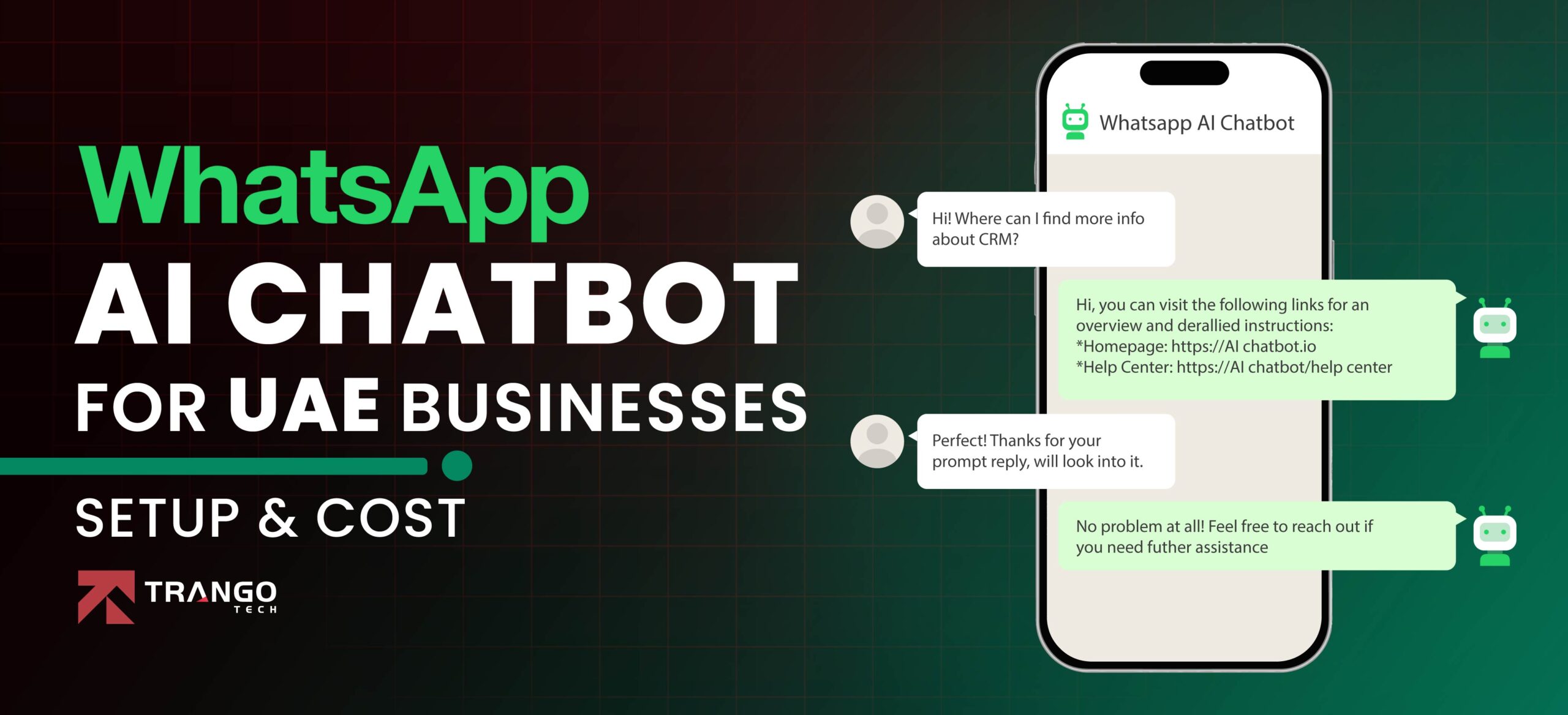
WhatsApp is used by About 9 out of 10 residents (roughly 83 to 90%), and you’re still wondering whether you should tap into a WhatsApp AI chatbot or not?
Thank you for reading this post, don't forget to subscribe!With this higher penetration rate, it’s pretty sure that your customers are there too. It’s a huge opportunity for businesses, as manually handling customer chats and actively replying to them can cause burnout, too.
This is where a WhatsApp chatbot comes into the scene and makes your lives easier than ever before. This will let you provide 24/7 assistance to your customers.
Whether you’re an e-commerce store processing orders, a service business booking appointments or a Shopify merchant recovering abandoned carts, this guide will help you understand how to create a WhatsApp AI chatbot that delivers an exceptional real-time experience.

A WhatsApp AI chatbot is a WhatsApp automation chatbot powered by artificial intelligence, such as large language models, that chats with users inside WhatsApp.
It chats with your customers right inside WhatsApp. It understands what customers are asking and replies the way a real person would.
To make conversations feel natural, many businesses invest in generative AI development. It lets the bot learn from your business data and reply with context instead of scripts.
UAE businesses are quickly adopting WhatsApp automation and AI chatbot integrations as customers today want quick and convenient digital solutions.
Below are some primary reasons:

The most prominent use cases for WhatsApp AI chatbots in Dubai can be seen in industries such as UAE’s retail, banking, real estate and government sectors.
This growth is fueled by the region’s high mobile penetration and preference for online buying.
When it comes to the real estate industry, the WhatsApp AI chatbot development helps in capturing inquiries from buyers and renters 24/7.
Furthermore, it also approves leads automatically based on budget, location and timeline. It also provides brochures, floor plans and schedules physical and virtual tours without the need for human intervention.
One of the most prominent use cases of a WhatsApp bot is in healthcare apps. It automates multiple tasks and saves staff time, such as appointment booking, doctor’s availability checks and insurance coverage questions.
A WhatsApp chatbot also takes care of pre-appointment reminders and reduces no-show rates by 25% to 35%. Along with that, it gives post-consultation follow-ups and sends notifications of test results.
Integrating a WhatsApp AI chatbot during e-commerce app development results in tracking live orders, processing returns and refund requests and managing abandoned carts.
It also offers personalized recommendations and promotions directly inside the chat. Connecting it with store inventory and CRM software also helps in multiple ways.
For education and training, it performs tasks like responding to course inquiries, fee structures, class schedules and admission requirements.
WhatsApp chatbot also sends automated payment reminders and application status follow-ups for prospective students.
In automotive and vehicle rental, WhatsApp AI chatbot easily tackles test-drive bookings, lease inquiries, vehicle availability and driver communications. It also facilitates initial finance pre-qualifications and model comparisons.
WhatsApp AI chatbots are widely used by restaurants, cafes and cloud kitchens in the UAE. Integrating them into food delivery apps helps in streamlining the whole process of food delivery.
Customers can easily browse the digital menus, place orders directly in the chat and track deliveries via live location sharing.
They also automate table reservations, send promotions and offers, and provide 24/7 multilingual support.

Here are some features that businesses must have in their WhatsApp AI chatbot.
A generic chatbot will be of no use for your business. Make sure your AI chatbot has a deep understanding of your business.
It should know the real pricing, policies and business hours. Without this knowledge, your chatbot will start hallucinating and provide false information.
A chatbot with WhatsApp CRM integration is necessary, as without it, it is just like it has never talked to your customers.
When any customer interacts with your WhatsApp AI chatbot, it should become a contact card with the whole conversation history, lead score, appointments, tags and AI-generated summary.
If it doesn’t store the history, understand that every conversation will start from zero, so what will be the use of an AI chatbot?
Your WhatsApp AI chatbot must be trained in a manner that it understands when it’s not the right tool for the moment.
Sometimes customers want to talk to a human agent, so in such situations the chatbot must notify the team on the alert channels.
It should be able to offer open slots for appointment bookings, create the event and send confirmation.
Its ability to check the calendar before offering a time reduces clashes. A list of available times you send is just an offer, not a held reservation. If the slot is taken in the meantime, the WhatsApp chatbot has to offer another option.
WhatsApp AI chatbot must send a reminder if you have not responded to a customer question.
Offer interactive button menus instead of the same boring menus like “tell me what you need”. Instead, offer buttons like pricing, book a call, technical support and talk to a human.
In this way, you can reduce misunderstandings and allow the customers to reach the desired outcome quickly and easily.
Your WhatsApp chatbot Dubai must support Modern Standard Arabic alongside regional dialects (eg: Khaleeji, Egyptian, Levantine). It should also support efficient English-Arabic code-switching.
Make sure to integrate a knowledge base (RAG) to safely fetch real-time data from internal databases, PDFs, and FAQs, minimizing AI hallucinations.
Include in-chat forms and workflows for multi-step tasks like bookings, scheduling and data collection without leaving the app.
It must also be integrated directly with WhatsApp Catalog to display products and native WhatsApp Pay for end-to-end checkout.
Your WhatsApp AI chatbot must have an analytics dashboard with an AI advisor. It lets you know how many contacts you have this week. What time of day do leads come in? Which questions is the bot failing to answer?
An AI advisor can highlight these insights proactively.

Creating a WhatsApp chatbot seems challenging, but with the right approach and tools, you can have a functional chatbot delivering real-time value.
You need WhatsApp Business API access for chatbot integration. Here’s how you can get access.
Before building, you should know the purpose of your chatbot. And ask yourself a few questions.
What is the primary use case? Will it tackle the customer support FAQs? Book appointments? Process orders? Recover abandoned carts? Qualify leads? Specify 4-5 tasks.
Note how customers interact with your business and what issues they are facing.
Set success metrics: how will you measure the success of your chatbot? Usually, the KPIs are response time, resolution rate, and customer satisfaction scores.
Also decide when your WhatsApp AI chatbot should transfer the conversation to human agents. This includes complex complaints, refund requests and emotional situations that need empathy.
Selecting the right platform for your WhatsApp chatbot in Dubai is a critical factor. Consider the following factors:
No-code vs. code-based: For non-technical teams, no-code platforms are the right choice. Technical teams might prefer code-based solutions for enhanced customization.
Make sure the platform supports modern AI models like GPT-4, Claude and Gemini. They must also support features like natural language understanding, sentiment analysis, and contextual memory.
The platform should smoothly integrate with your existing tools, Shopify, CRM systems, payment gateways, customer databases and analytics tools.
Plan how the conversation will take place. It is even helpful for AI-powered chatbots as well.
Write a Script of the actual messages your bot will send. Keep it simple, in natural language, concise and aligned with your brand voice.
Use WhatsApp rich features, list messages, quick reply buttons, product catalogs, images, and documents to create engaging experiences.
Make a plan beforehand for situations when the bot doesn’t understand. Include graceful fallback messages.
Create a secure server endpoint to receive real-time notifications from Meta and verify it using a secret token.
Training is very important for quality responses, so make sure to feed your chatbot product catalogs, FAQs, policy documents, website content and any information that will be needed to answer clearly.
Show an example of good customer interaction, including how to handle common scenarios and edge cases.
Set the brand voice guidelines, mentioning how the chatbot should communicate. Specify the tone, such as casual, formal, professional, friendly, or technical.
Make the Guardrails too, for what the bot should and shouldn’t discuss.
Make sure to test it thoroughly, as rigorous testing prevents embarrassing failures and poor customer experiences.
Launch is just the beginning. Ongoing maintenance guarantees sustained success. Here’s what you can do to achieve success:
Opt for a soft launch and start with a limited audience, like existing customers, so that you can identify the issues in a controlled environment.
Track response times, resolution rates, escalation rates, conversation volumes, customer satisfaction scores and conversion rates.
Regularly review conversations to identify the common pain points and FAQs that have become challenging for the bot.
Use insights from monitoring to continuously refine the conversation flows, add new capabilities and fix issues.
Choosing the best approach depends on your budget, engineering resources, and data privacy requirements.
For businesses targeting the Middle East, Arabic language dialects like Egyptian and Khaleeji versus Modern Standard Arabic is often the deciding factor.
| Feature | Saas CRM/ Automation tools | ChatGPT Style Builders | Custom-Built AI Chatbots |
| Cost | Low to moderate | Low | High |
| Arabic Quality | Depends on rule-based keyword matching and basic translation APIs. | Uses underlying LLMs (OpenAI, Anthropic) | AI agents can be integrated with Arabic-optimized models |
| Integrations | Integrations with Shopify, HubSpot, Zapier,and WhatsApp Business API | Requires webhooks, Zapier or basic API configurations to connect to external databases | Can be deeply hardwired into proprietary legacy software, internal ERPs and custom databases. |
| Data Control | Data lives on thyroid-party saas servers. | Data passes through AI vendors. | Can be deployed on-premises or within your secure private cloud. |
| Scalability | Scalable in terms of user volume | Limited by memory space and speed rules. | Architecture can be adjusted to handle complex workflows natively. |
Direct Answer: Setting up and running a WhatsApp AI chatbot in the UAE typically costs between AED 300 and AED 2500+ per month. It also depends on the provider, the level of AI features and message volume.
| Cost Component | Basic Tier | Mid Tier | Advanced Tier |
| Initial build and setup | AED 7000 | AED 15,000 | AED 40,000- 90,000+ |
| BSP/Platform/Monthly support | AED 690/month (up to 1000 dialogs) | AED 1490/month (up to 2,000 dialogs) | AED 2500+/mo up to 4000+ dialogs/ custom SLA |
| Meta Messages Fees | AED 0 to AED 100/month | AED 150- AED 600/month | AED 1000+ /month |
| LLM/ AI Token Costs (OpenAI, Claude/ API) | AED 40-AED 150/month | AED 150- AED 500 per month | AED 1000+ per month |
| Estimated Total First-Month Cost | AED 7880- AED 8,000 | AED 17,200- AED 18,000 | AED 43,500- AED 94,500+ |

Running a WhatsApp AI chatbot in the UAE needs strict alignment with Meta’s commercial policies, UAE telecommunications guidelines (TDRA) and federal data privacy laws (UAE PDPL- Federal Law No. 45 of 2021).
You must have proof, in the form of a document, that the user agrees to receive messages from your business on WhatsApp.
Under Cabinet No. 56 of 2024, the UAE applies marketing controls that cover marketing messages across social media and messaging apps like WhatsApp.
Your workflow must have the option for “STOP” or an opt-out request immediately. If a user chooses this option, the system must immediately stop future messages and block the scheduled messages as well.
You have a 24-hour session window, so when a user messages your business, you have a 24-hour window to reply freely with standard customer service messages.
After the 24-hour window, you must use pre-approved WhatsApp message templates.
Meta doesn’t allow your business account to send messages to people who do not explicitly ask or agree to receive them.
Sending messages without any request from users is against the WhatsApp Business messaging policy and triggers specific consequences.
Your WhatsApp AI chatbot should not spam users with too many messages and must have built-in, unskippable ways for users to pause or stop the interactions entirely.
This law makes sure that personal data of the users processed via chatbots must be handled lawfully and securely.
Make sure to update your privacy policy to include the storage locations and user rights.
The WhatsApp chatbot must be polite and use culturally appropriate language. It should know when to use standard Arabic and when to use localized Gulf Arabic.
Its speaking style should be courteous and formal, in UAE business communications, not overly generic or robotic translations.
Program your WhatsApp AI chatbot to hand off the chat to the live human agent immediately when the user explicitly asks to speak to a person.
It should pass the full chat transcript and customer profile to the human agent so the user does not have to repeat themselves.
You should take a customer survey after the conversation is resolved. It can be done by giving rating prompts such as a 1-5 scale or thumbs up or down.
Does WhatsApp have an AI bot?
Yes, WhatsApp has a built-in AI assistant called Meta AI. It can do multiple tasks, such as chat and answer questions, and allow you to create & edit images from text prompts; you can also tag Meta AI in group chats to ask questions.
How do I make a WhatsApp chatbot?
Steps to build a WhatsApp chatbot are: set up a WhatsApp Business account and API, choose a no-code chatbot platform, train your chatbot, design the conversation flow, connect and test.
Is a WhatsApp bot free?
Building and testing a WhatsApp chatbot can be free, while running a full-scale business bot usually costs money over time.
How much does a WhatsApp chatbot cost in the UAE?
The total cost of the WhatsApp chatbot in the UAE depends on the level of bot you want to build.
A basic AI bot may take AED 7,000 to AED 15,000
Mid-level & custom bilingual bot: AED 15,000 to AED 180,000
Enterprise-level LLM+ RAG Bots: AED 180,000 to AED 1,470,000+
Can a WhatsApp AI chatbot reply in Arabic?
Yes, a WhatsApp AI chatbot can reply in Arabic.
Do I need a WhatsApp Business API for a chatbot?
Yes, you need the WhatsApp Business API, which is now officially called the WhatsApp Business Platform, if you need a true, interactive chatbot or AI agent that handles automated conversations.
How do I get the green tick on WhatsApp?
To get the green tick on WhatsApp, your business must use the Whatsapp business platform/API and meet specific requirements set by Meta.
Can the chatbot connect to my CRM?
Yes, an AI chatbot can connect to your CRM such as HubSpot, Salesforce, Pipedrive, or Zoho.
A WhatsApp AI chatbot is not a nice-to-have for UAE businesses. Your customers already live on WhatsApp, and they need quick answers in English or Arabic at any time. A chatbot gives them that without adding to your team’s workload.
The setup is simpler than most owners expect; you just need to have the right partner by your side. You pick a use case, pick a WhatsApp Business API access approval, connect the bot to your system, and test it before going live.
The cost of your WhatsApp bot depends on what you need. A basic FAQ bot has a lower cost, while CRM integrations cost more.
Meta’s per-conversation fees and ongoing maintenance fees also add to the total cost, so budget for them from day one.
Choosing among the many CRM application development companies in the UAE is harder than it looks.Thank you for…

Key Software Development Statistics at a Glance Category Statistic Value Source+Year Global software market size Valued at $823.92…

According to studies, the UAE accounted for 47% of all fintech deals and 69% of total funding in…
Choosing among the many CRM application development companies in the UAE is harder than it looks.Thank you for…
Key Software Development Statistics at a Glance Category Statistic Value Source+Year Global software market size Valued at $823.92…
According to studies, the UAE accounted for 47% of all fintech deals and 69% of total funding in…
If you are confused and need expert advice to transform your business, our experts are available 24/7.
Don't waste a single second, as you will be left behind while others are already ahead, moving fast. Start Now!
Trusted by Clients Worldwide: Rated 4.9 Star